Current contraceptive product development tends to be evolutionary, rather than revolutionary.
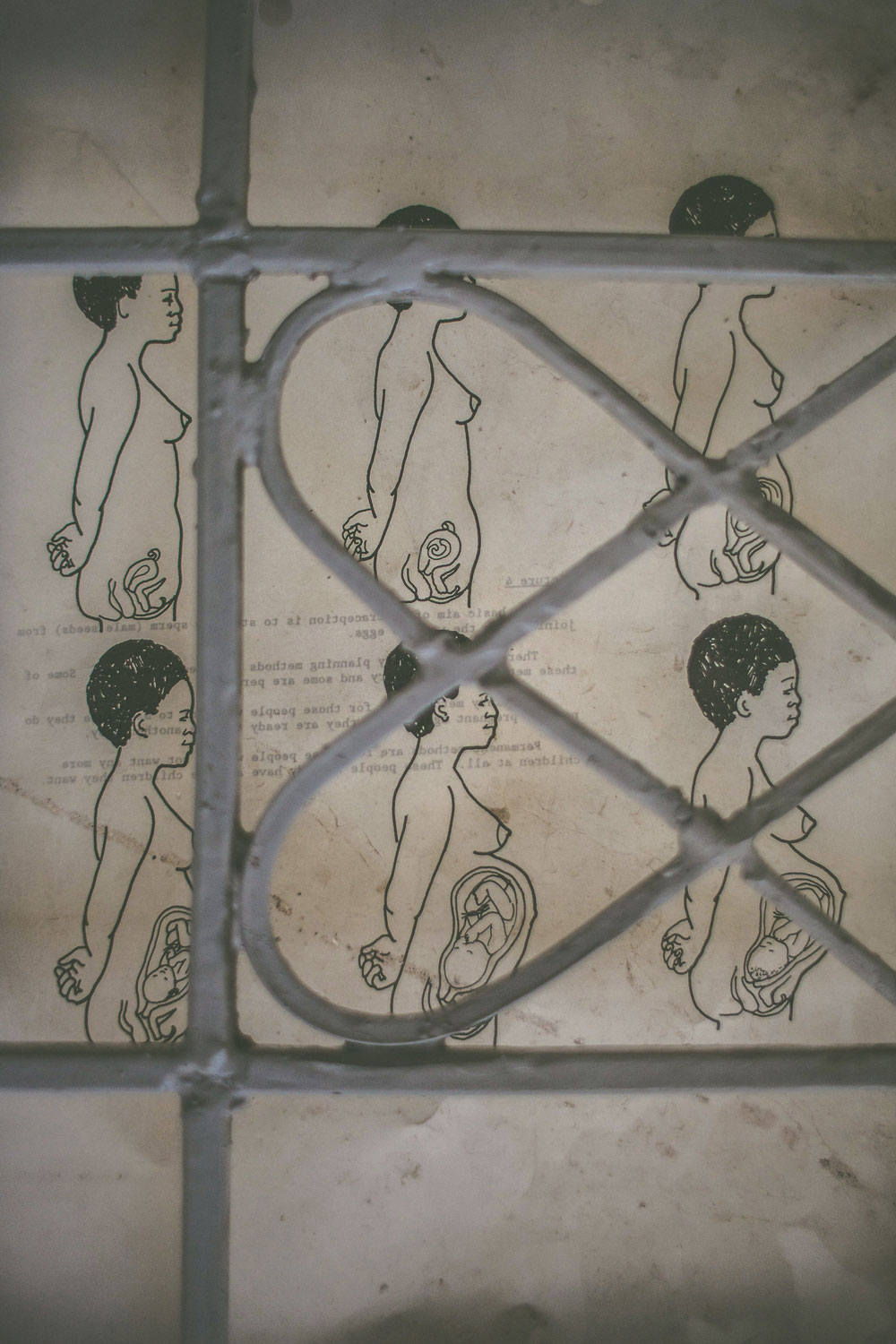
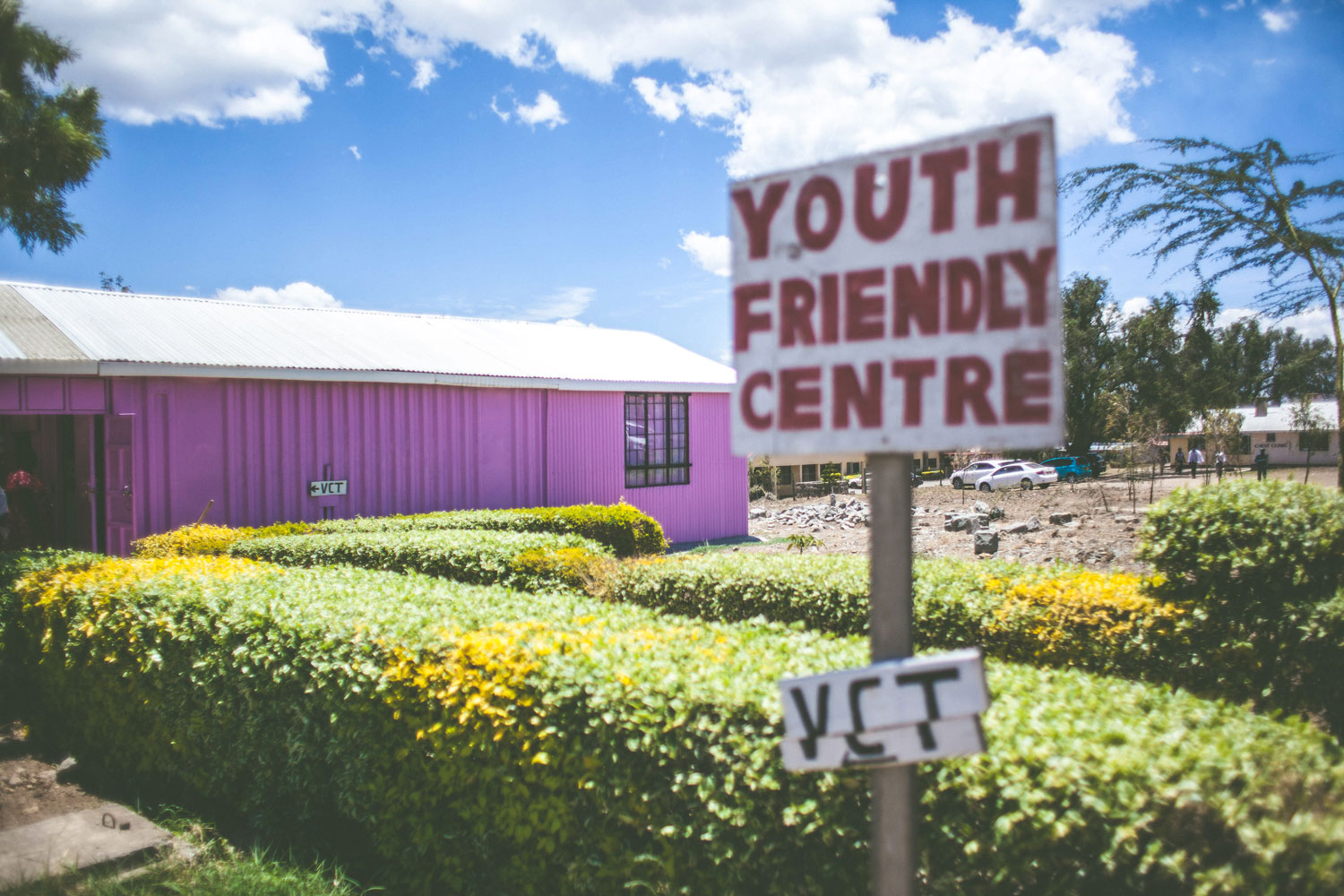
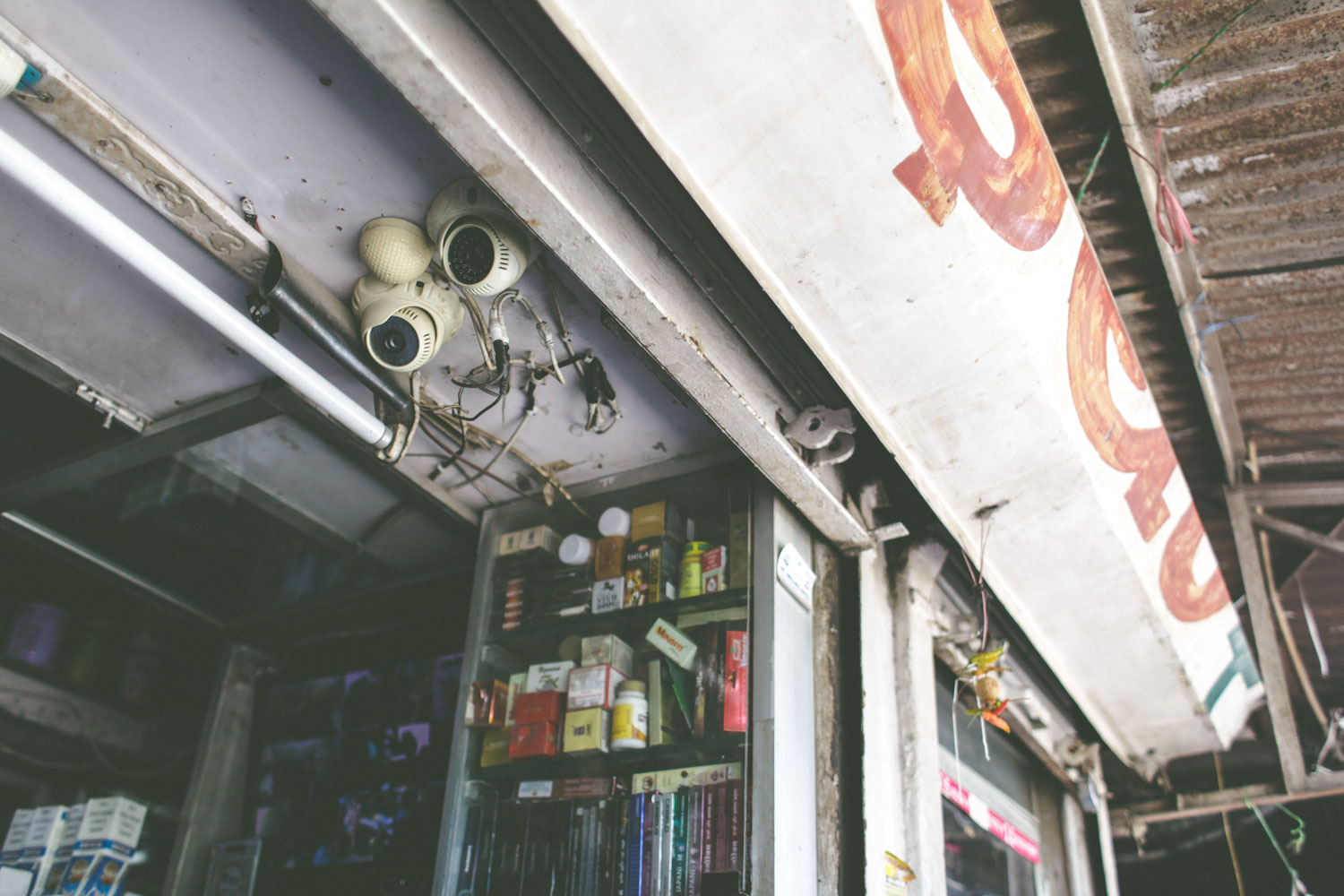
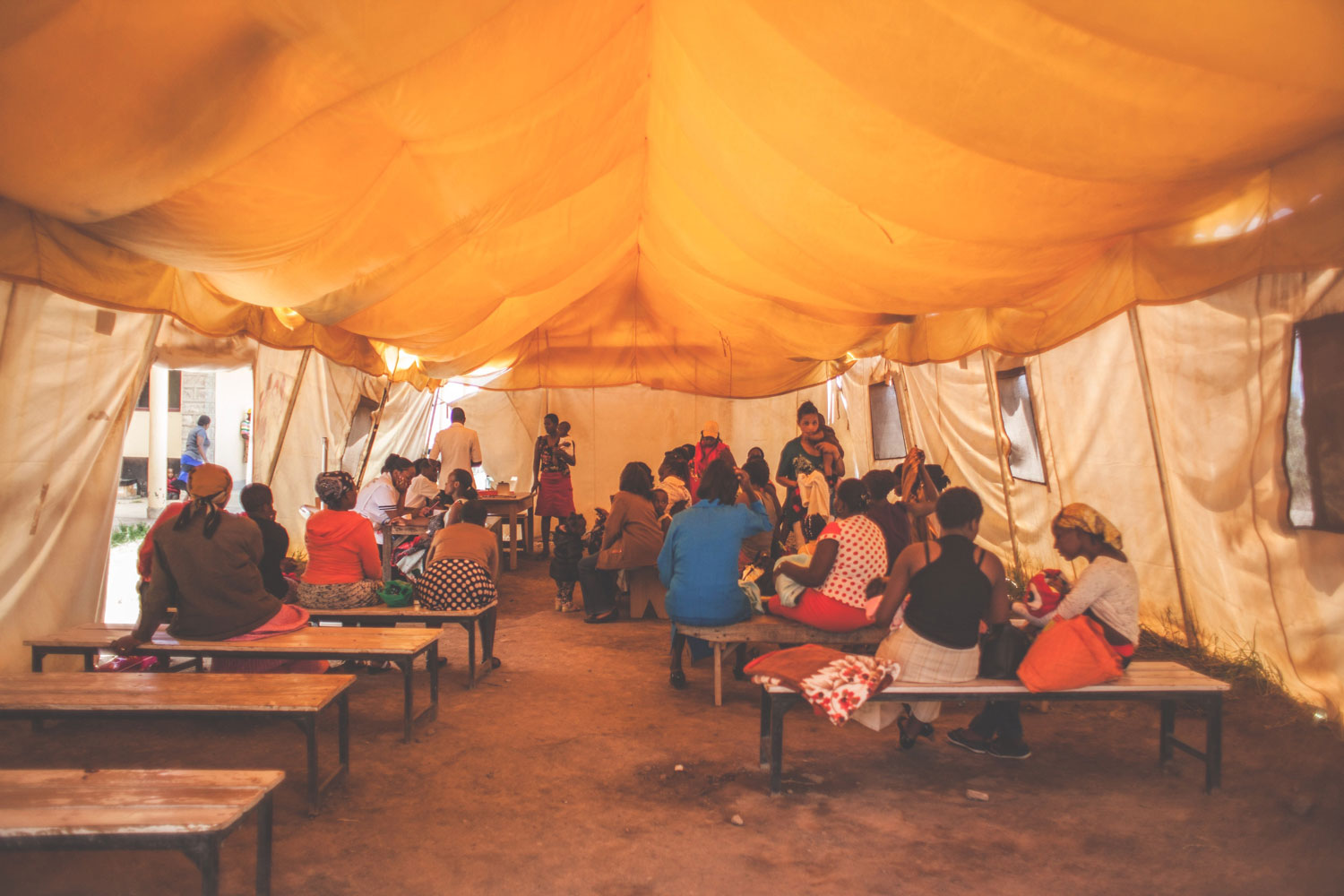
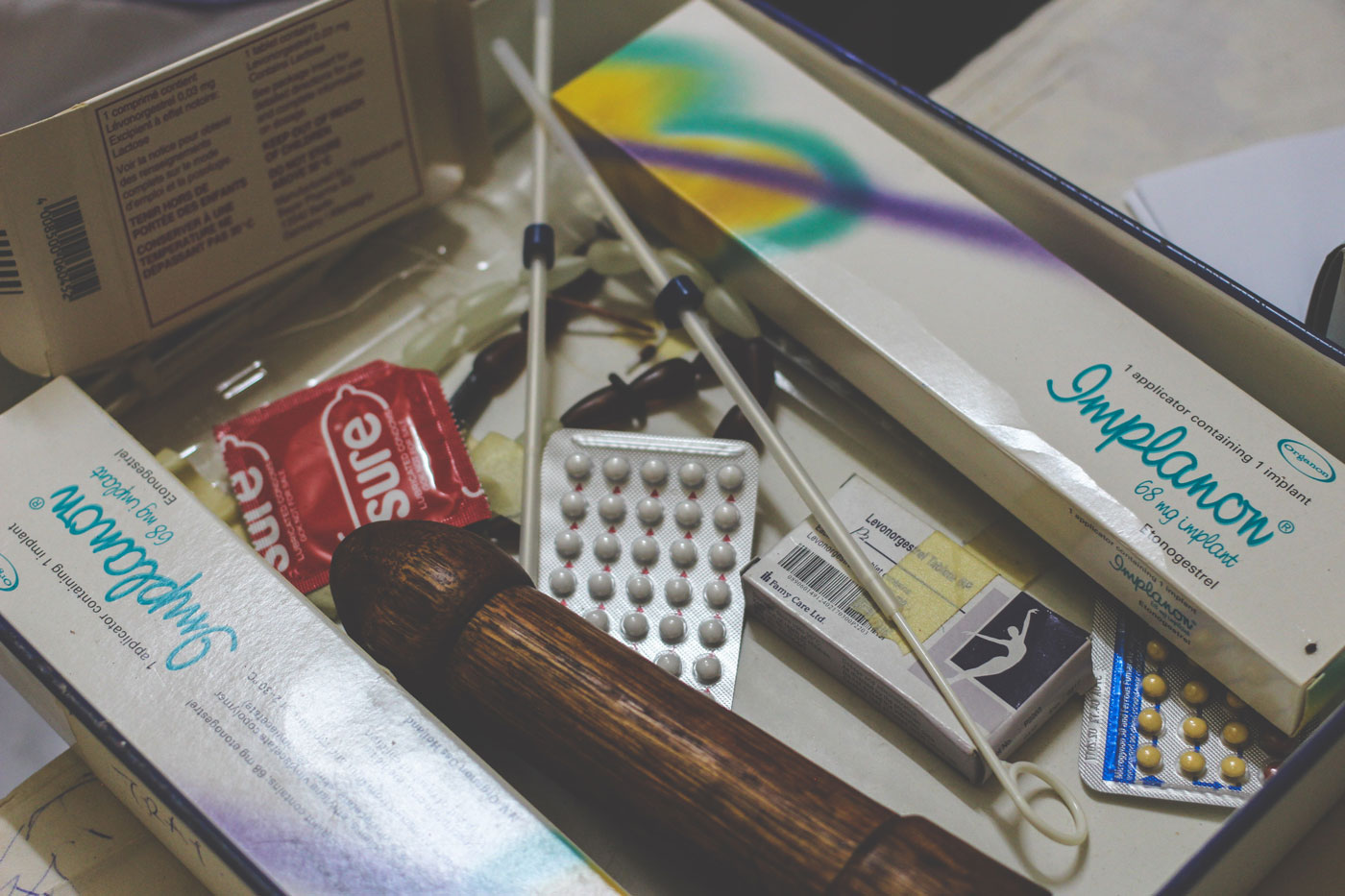

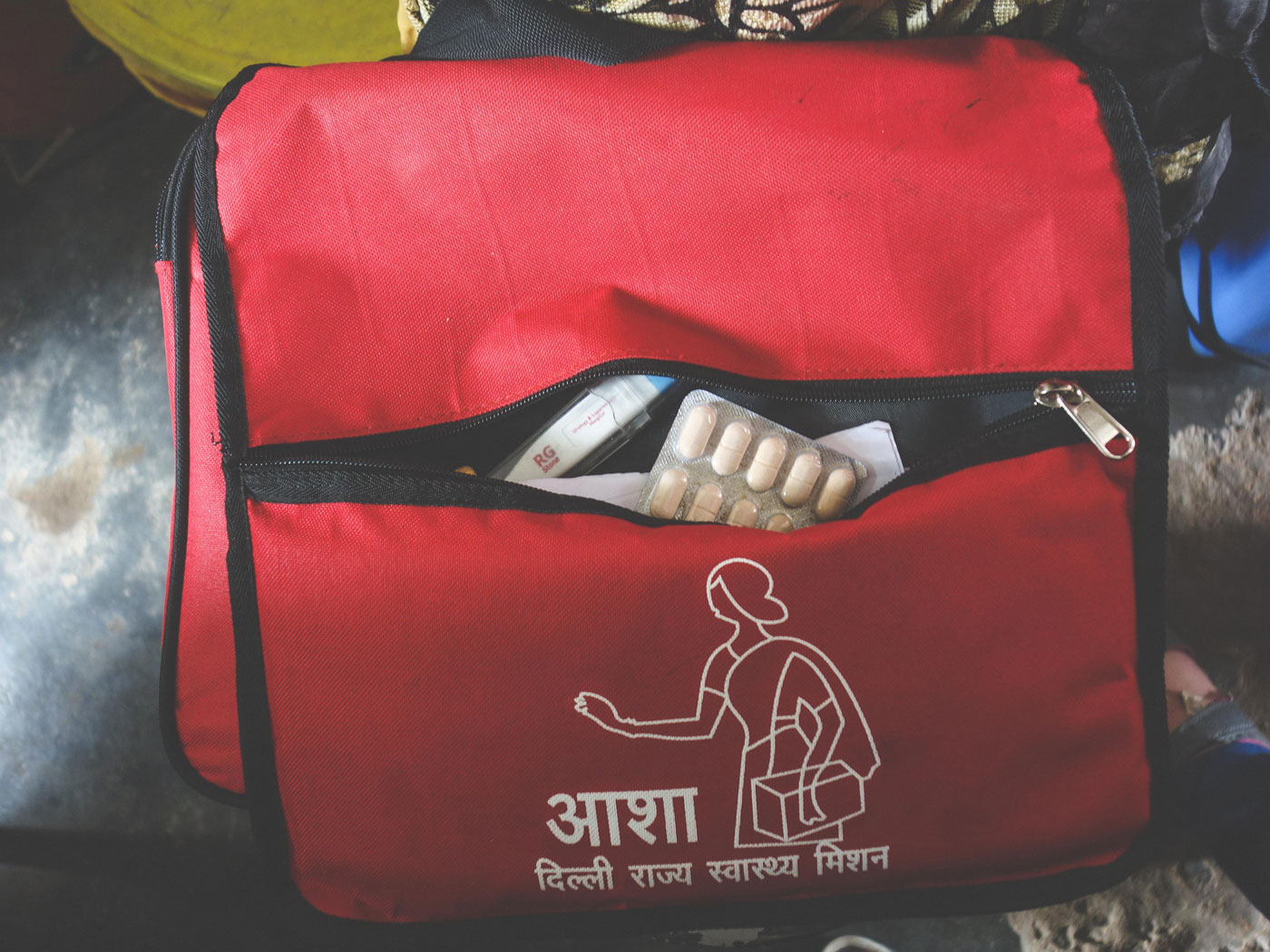


The project took place in Kenya and India - countries which were strategically selected as regional 'bellwethers' for (East) Africa and (South) Asia.
These countries were selected to approximate the range of geographic, sociocultural, and service delivery contexts encountered by contraceptive users in low-income countries.
Research locations:
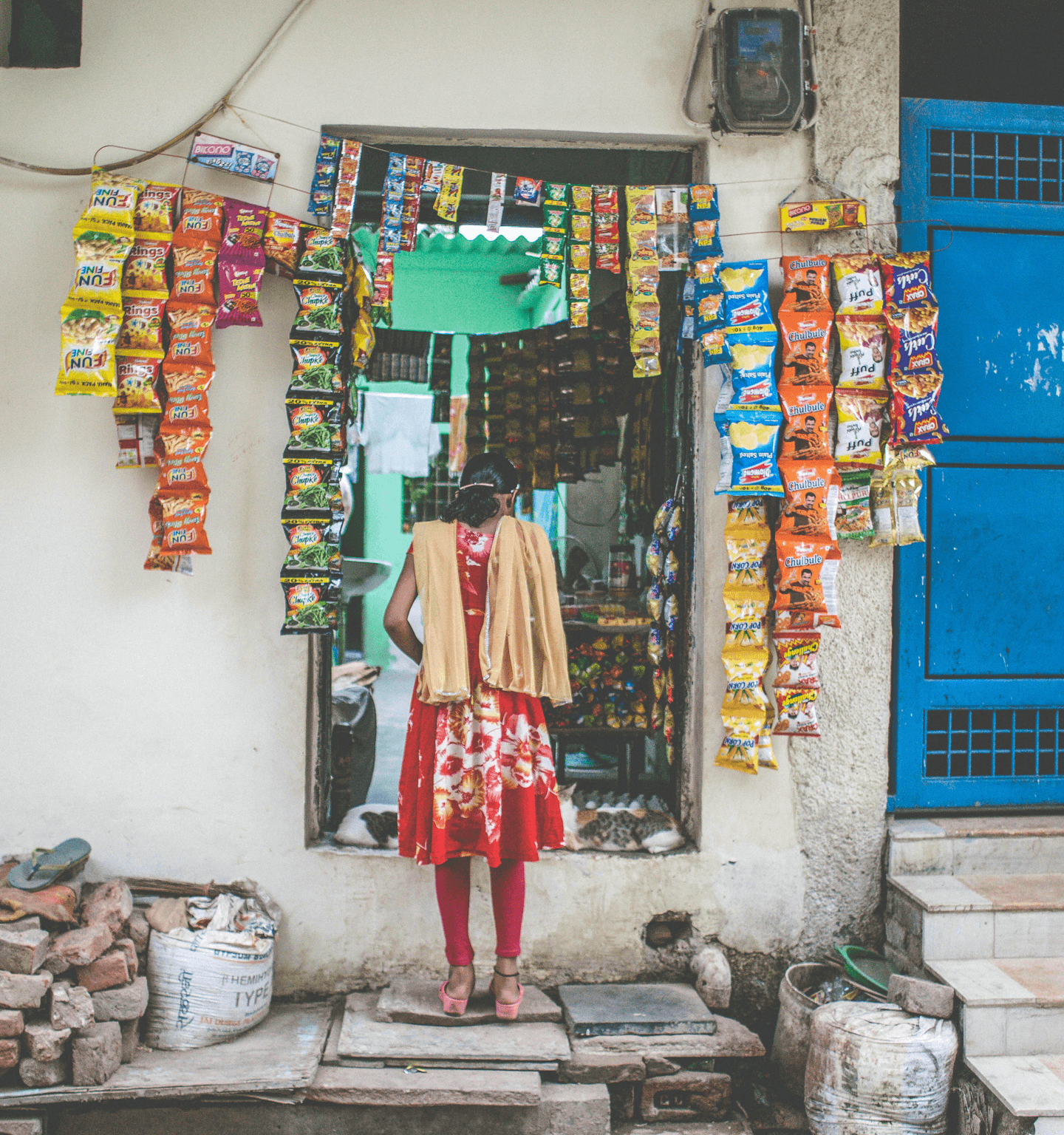
Kenya : Nairobi, Naivasha, Nakuru, Kisumu; India: New Delhi, Kolkata, ShantiniketanIn the course of our research, we visited homes, hospitals, schools, markets and places of work to meet and observe people in their daily lives.
We interviewed women, as well as their partners, doctors, teachers, community leaders and various other stakeholders to understand the influence they had on our key users, the women we are designing for.
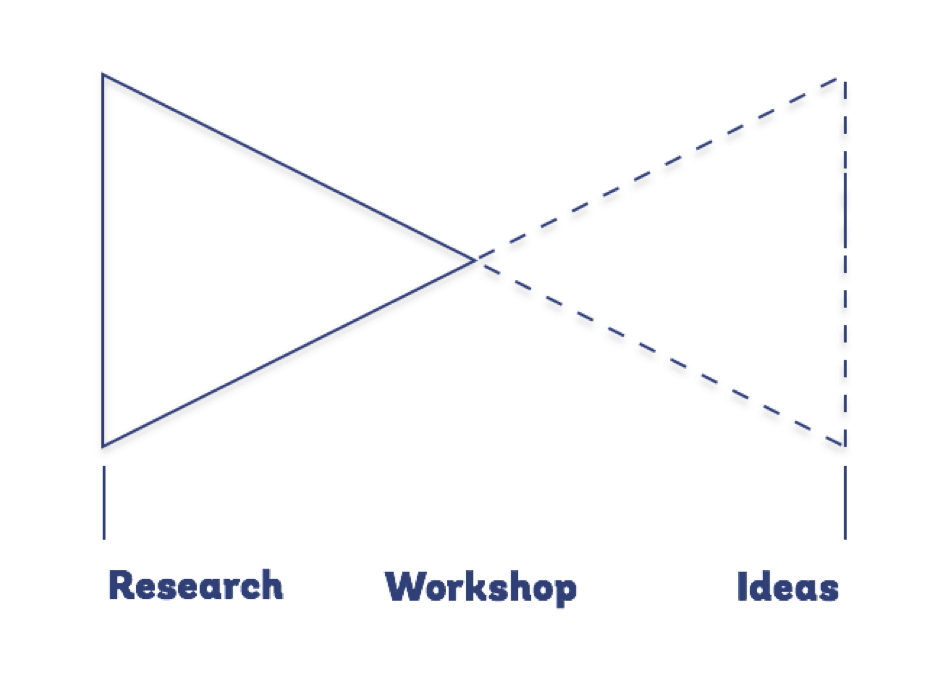
In each country, we organised ideation workshops bringing together a diverse set of local and global experts, to leverage the research findings and generate ideas relevant for the far-future of women’s contraception.
A Day in the Life of women across Kenya and India.
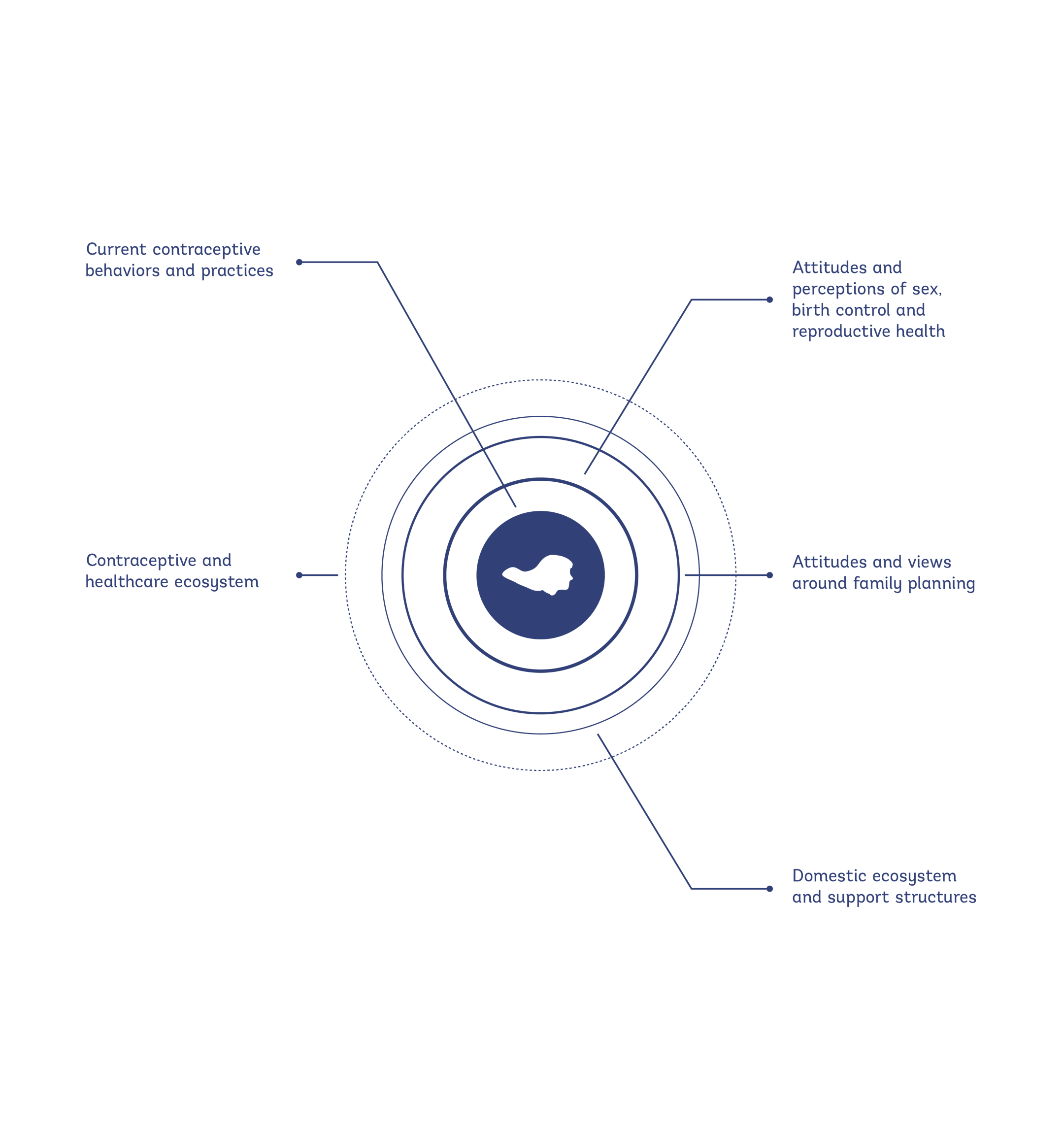
Contraceptive use is impacted by multiple factors; attitudes and behaviors around use of products, perceptions of the community towards family planning, access to health care are some of these.
The lines of enquiry provides a framework for navigating this macrocosm.
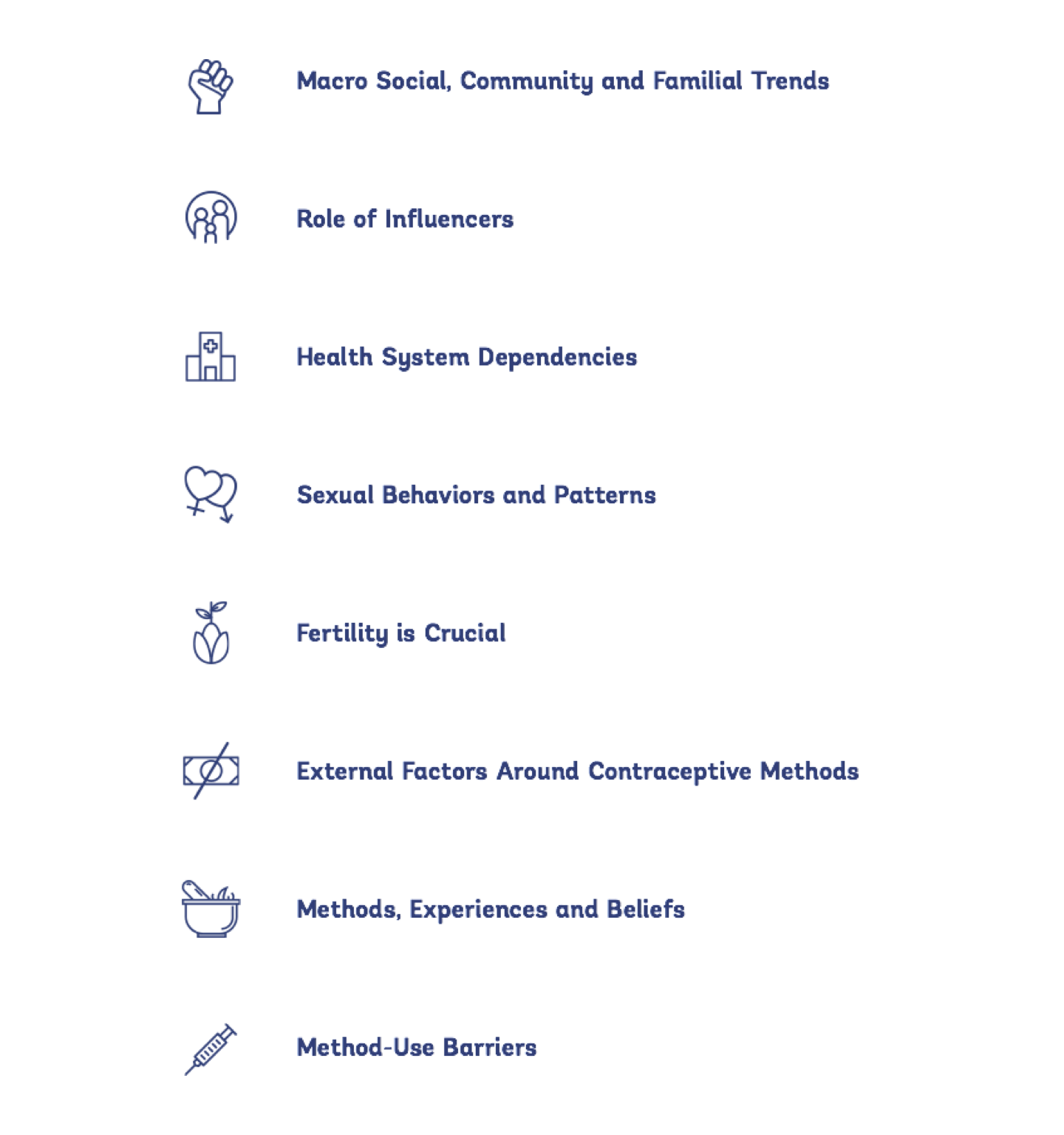
At a cultural level, even though social norms and practices are changing, traditional roles for women persist. Women’s need to be able to demonstrate and protect their “fertility” is paramount.
 Macro Social Community and Familial Trends
Sex and sexuality remain taboo topics in many settings. This means that for some groups, such as young unmarried women, even when contraception is available, it is not accessible because of the stigma attached.
 Role of Influencers
Family planning is often positioned as being child-centric rather than woman-centric. Methods are difficult to access for women who have not had a child.
 Health System Dependencies
Sexual partners, family members and service providers have significant influence on a woman’s contraceptive decisions. Being able to use contraception discreetly can be critical, especially when a woman is not in an equal relationship.
 Sexual Behaviours and Patterns
A woman’s sexual and reproductive health journey - from menarche to menopause - has several key milestones that drive distinct contraceptive behaviors.
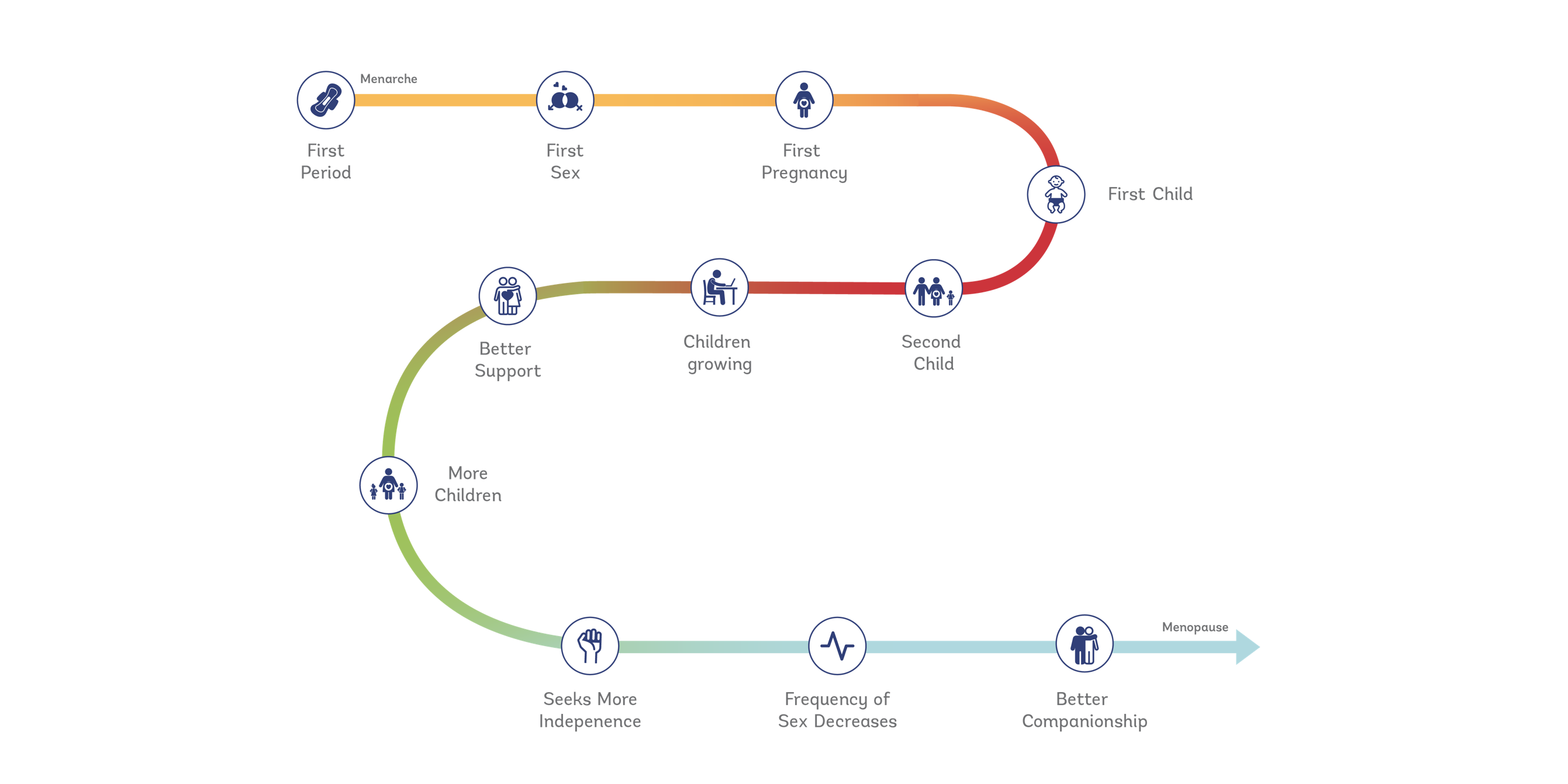
These are summarized into four key phases that exemplify the changing role of a woman across her life.
As women go through these phases, their aspirations and motivations change, as do their contraceptive needs.
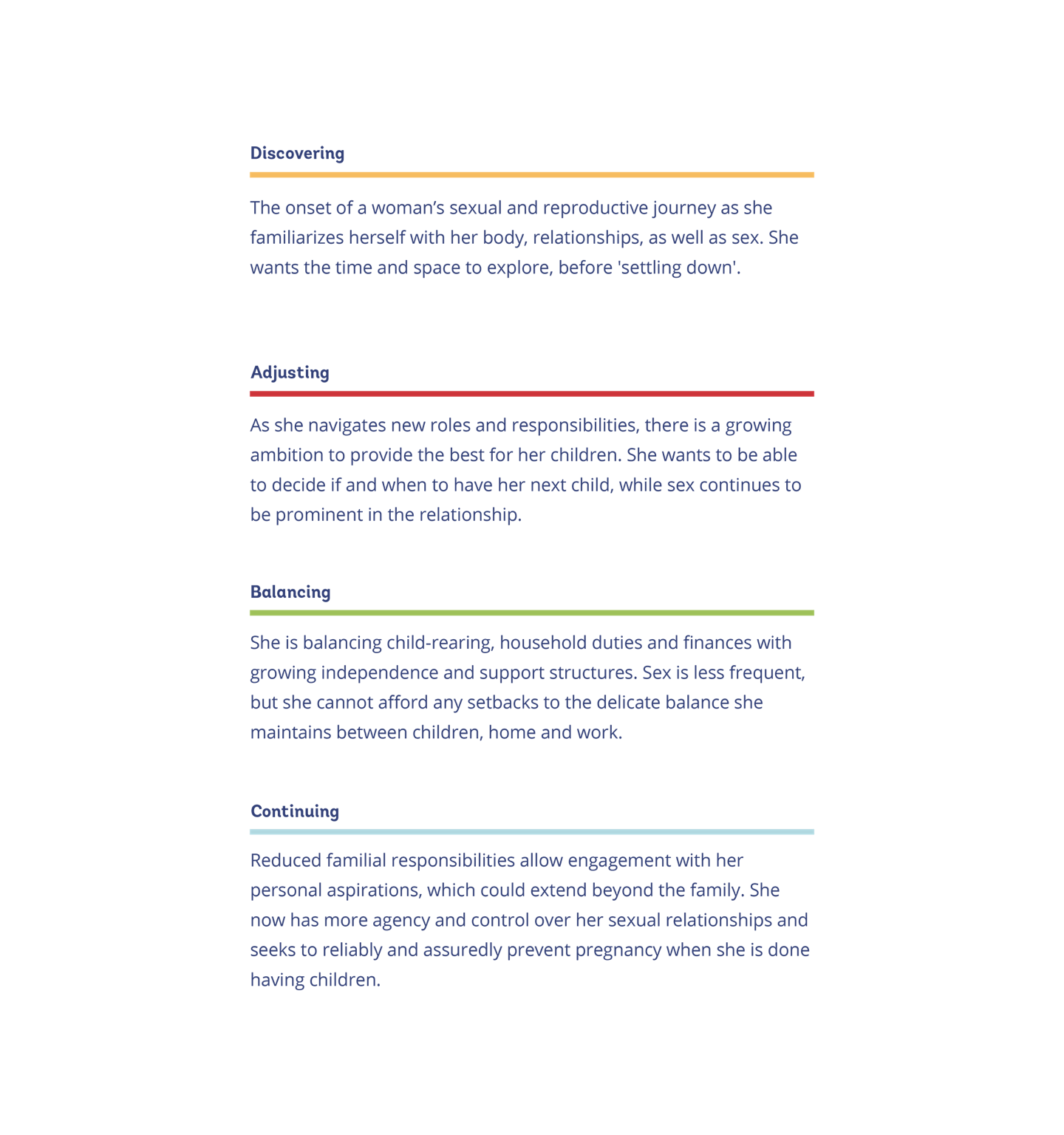
There is no one contraceptive product that suits the varying needs of all women.
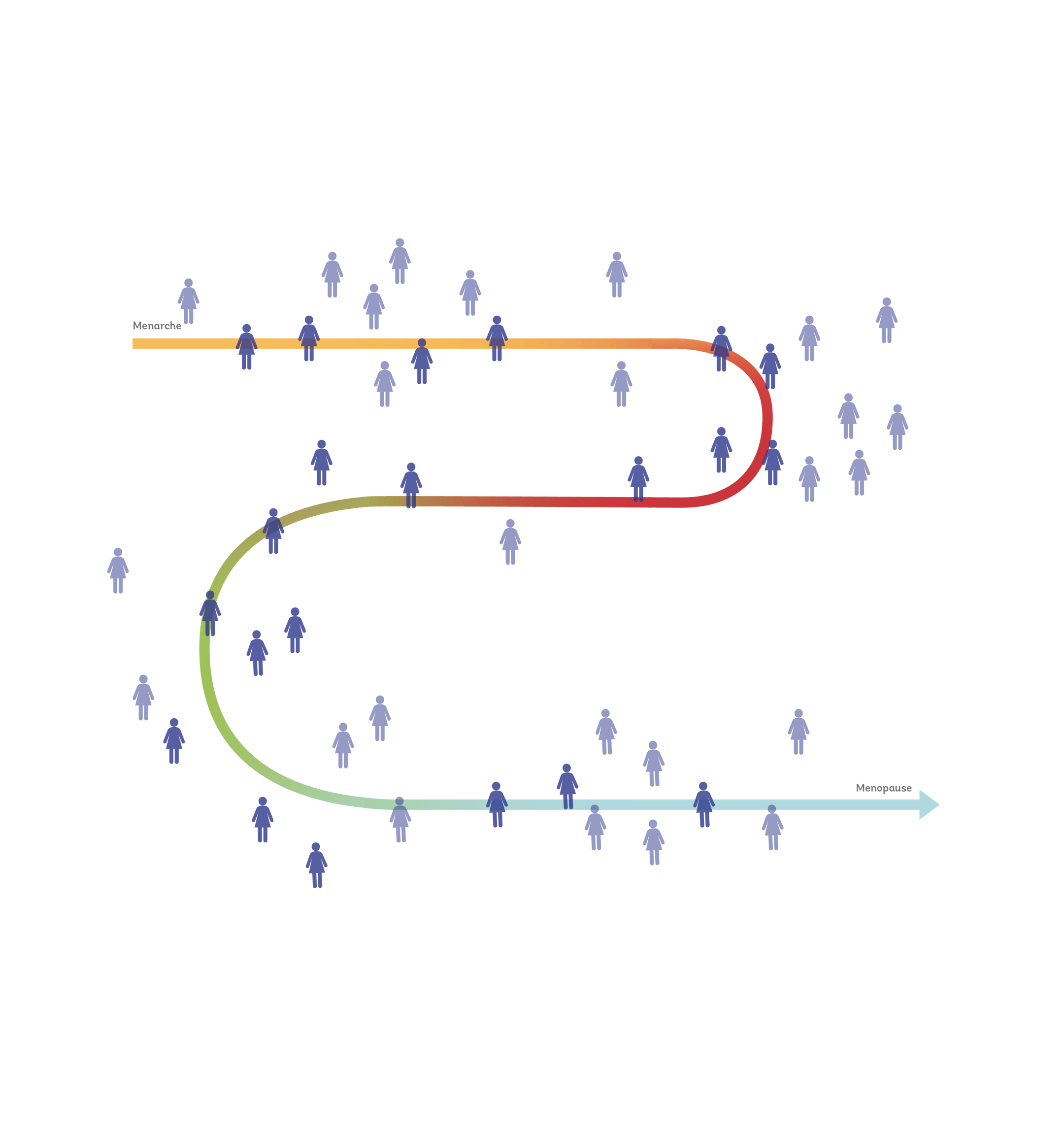
User profiles typify a range of women at a specific life stage, who have similar aspirations, influencers and contraceptive needs, leading to a certain set of unmet needs that are unique for that profile.
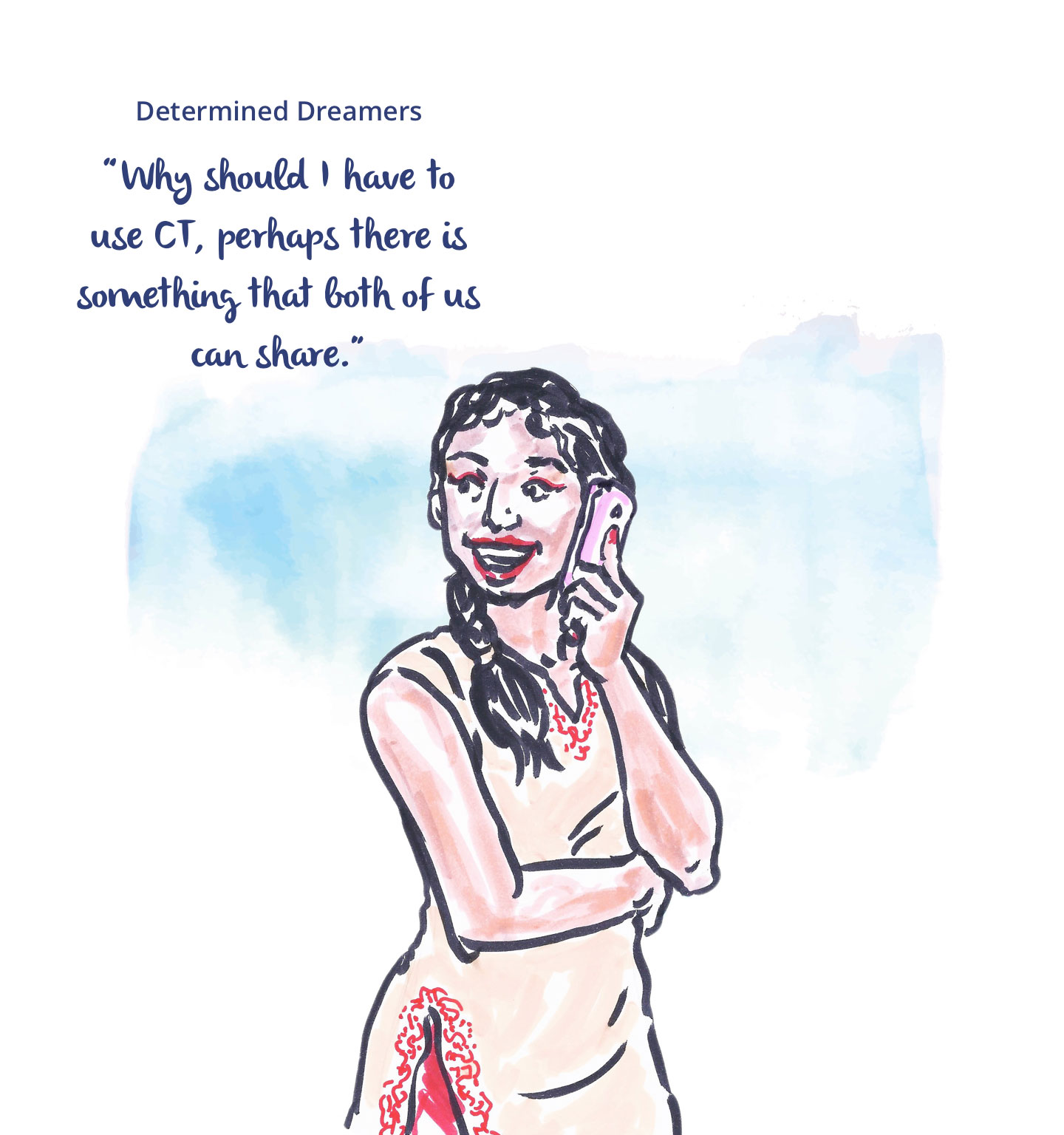
Determined Dreamers -
A spirit of determined independence defines this modern woman; she is ambitious and will not settle down before achieving her dreams. She is prudent about her sexual choices, as she wants to focus on her future.
Enablers - She has a strong group of friends and peers who encourage and support her and provide a safe space for self-expression.
Barriers - She gets her information through peers and school activities such as health clubs, faith-based sermons, which can be fairly biased and limited to abstinence-only messages.
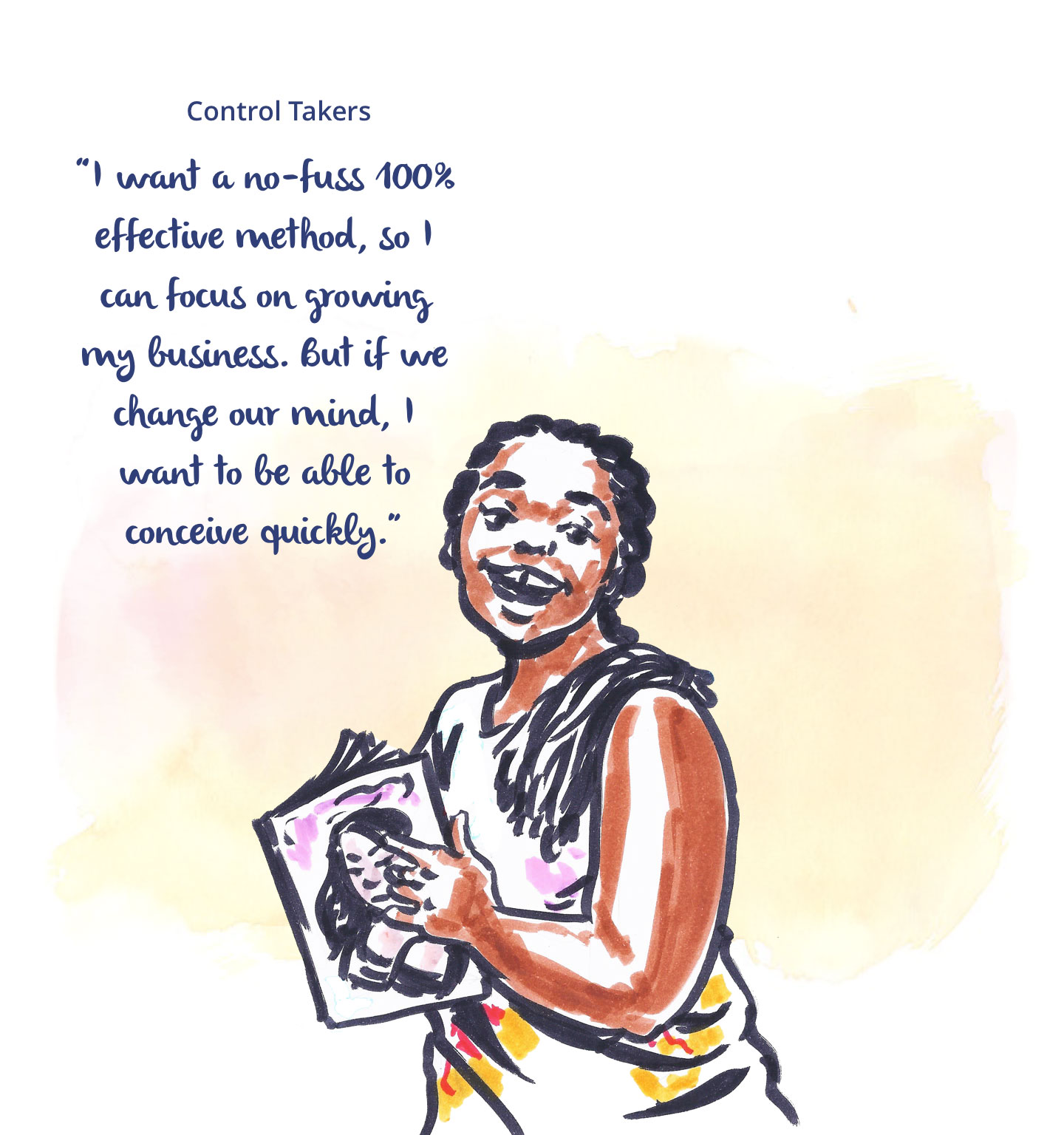
Control Takers
She is an ambitious risk-taker who seeks to become more independent financially and wants to focus on expanding her own business.
Enablers - She enjoys working, particularly because her employers have supported her transition into an entrepreneur and even assisted her financially.
Barriers - Struggling to balance work and family, she is stressed, which ultimately takes a toll on her health. Her busy life might also affect her relationship with her partner, who wants more time with her.
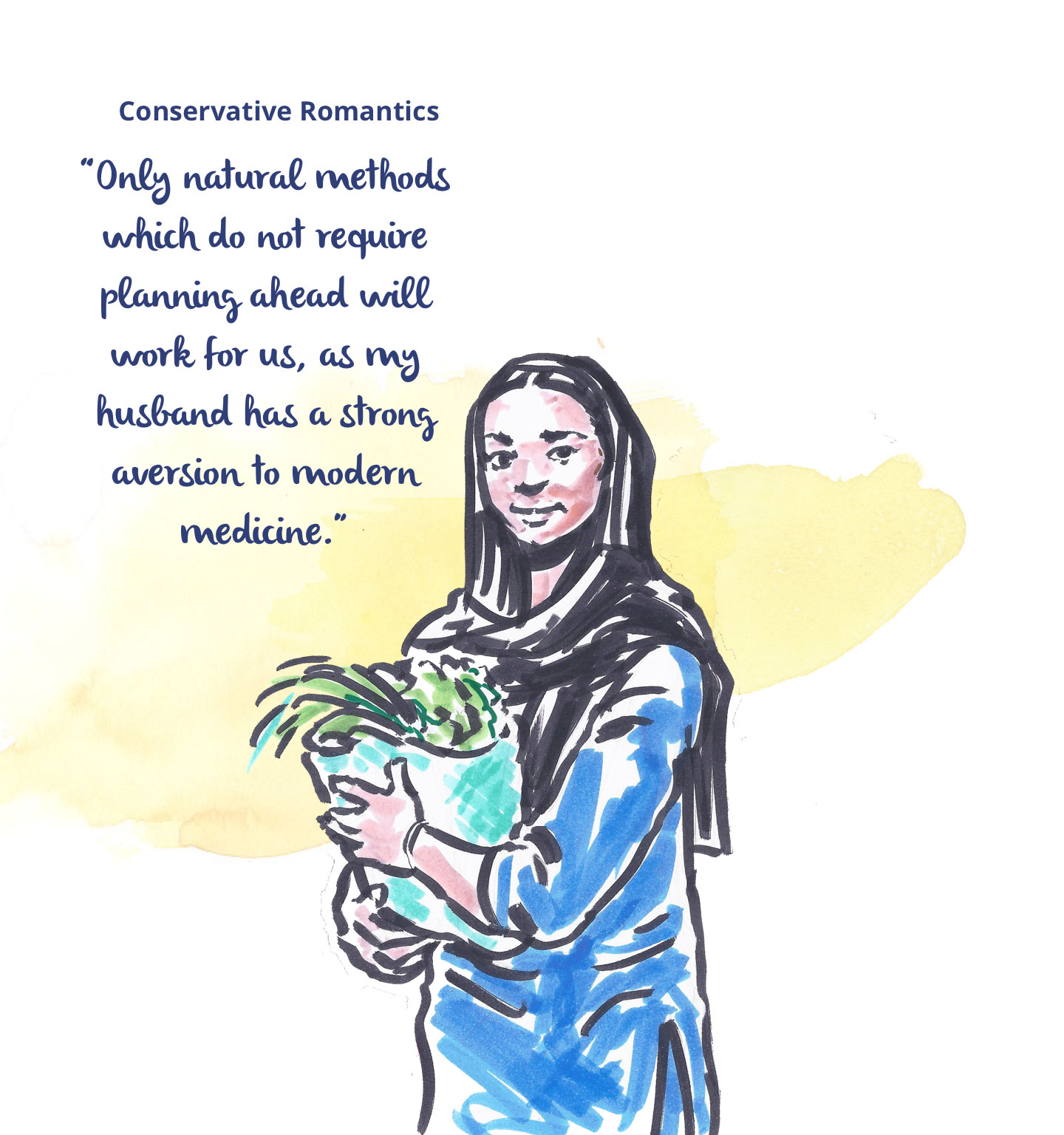
Conservative Romantics
She is in a stable relationship and seeks support and guidance from her partner, whom she is financially dependent upon. She has traditional values and dreams and seeks stability through achieving family goals.
Enablers - She has a caring husband, who earns enough to take care of the family and feels she needs to only manage the household.
Barriers - Owing to her unfinished education, she feels under-confident of her own abilities and relies on her husband or other ‘knowledgeable’ people such as health providers to make decisions for her.
Design considerations are a distillation of user needs, presented as a series of illustrated provocations.
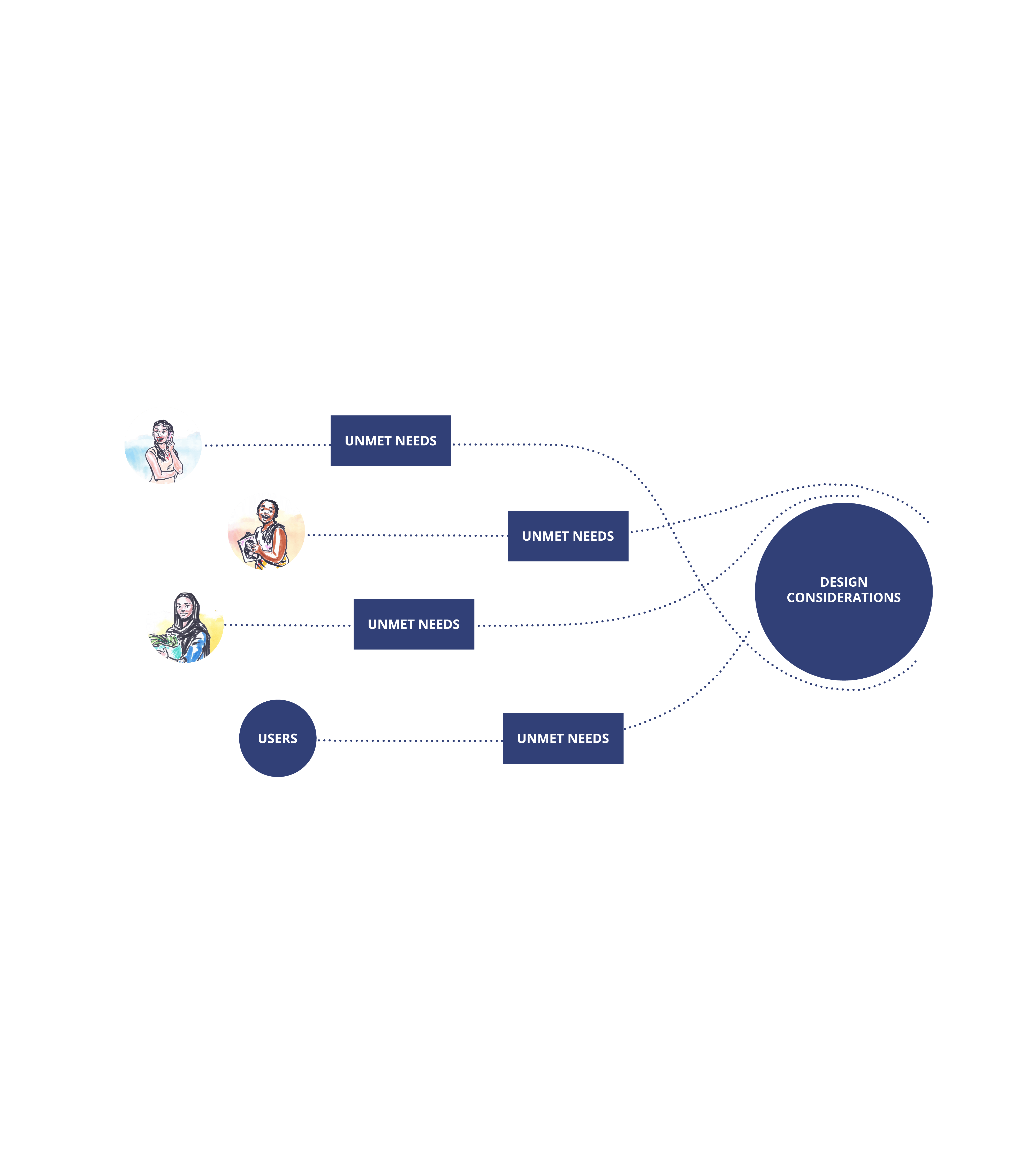
They serve as a framework for designing and developing compelling contraceptive products, which significantly enhance the user’s experience.
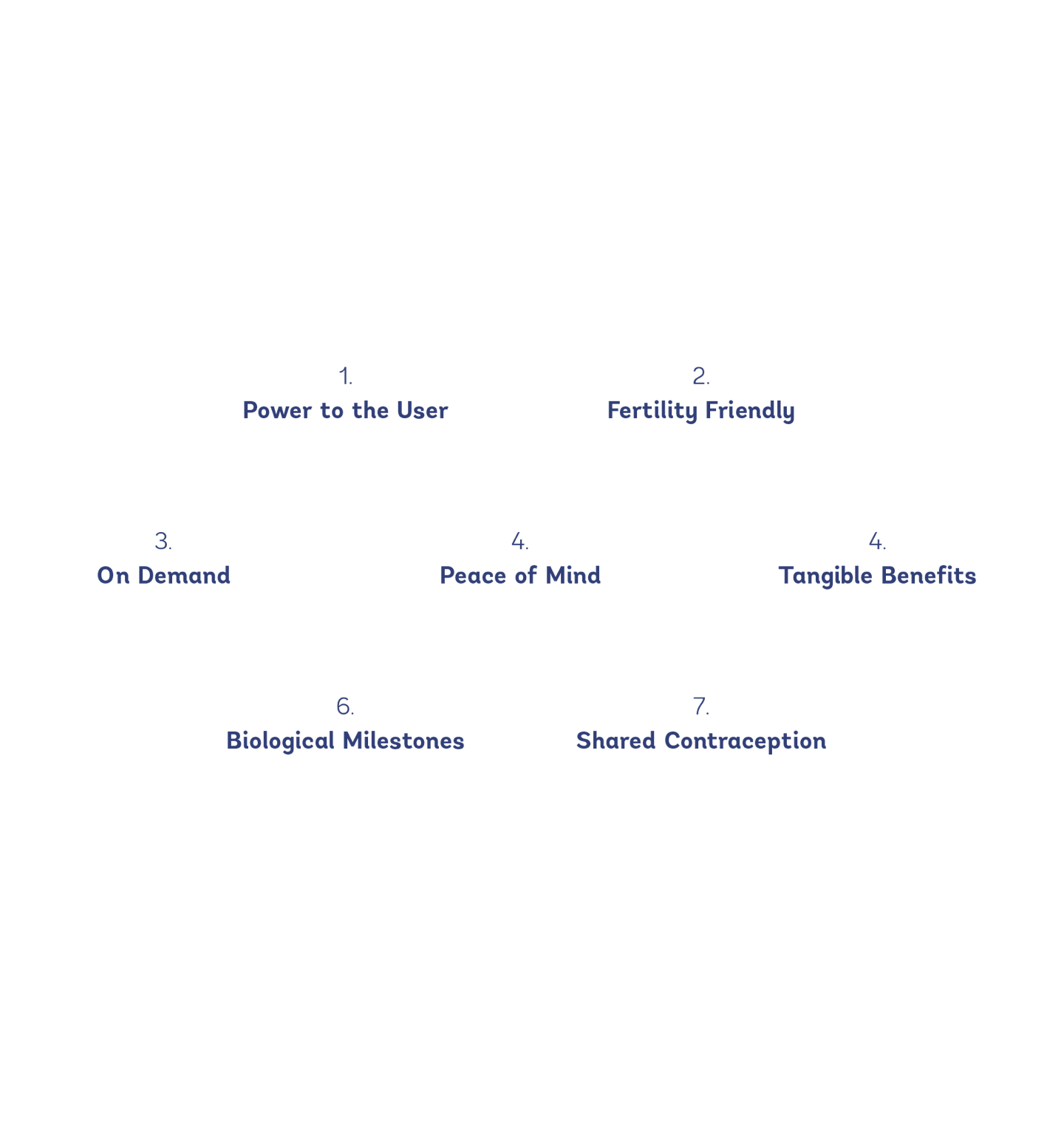
Power to the User
For many women, the use of contraceptives has to be on their own terms, when they want to use them and with limited reliance on service providers, thus giving power to the users.
Can contraception fit more discreetly into the everyday lifestyle of the women who use it?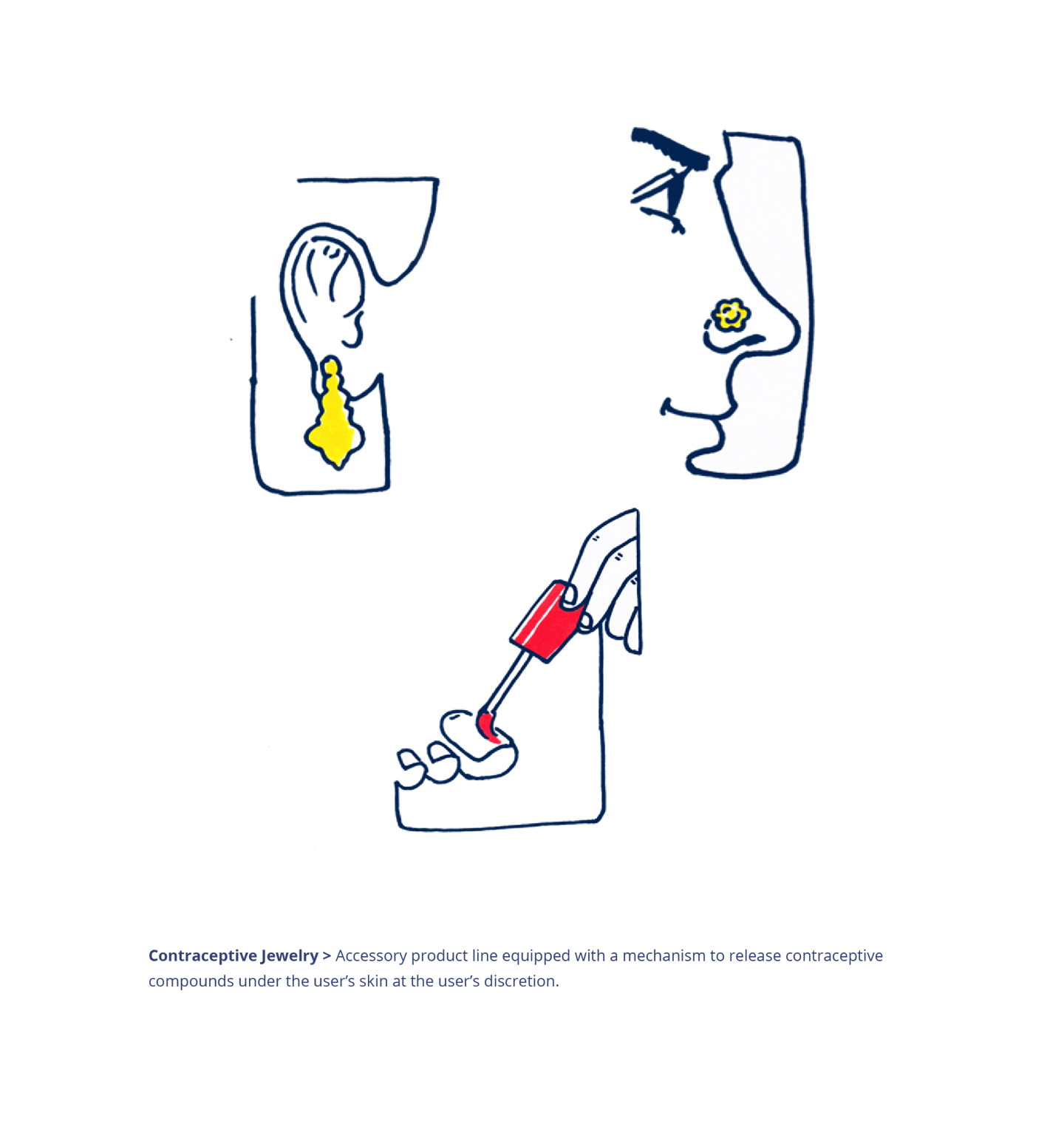
On Demand
Current contraception does not match the varied sexual behaviors of most users. Even when products are easily available, they still require some amount of pre-planning to work correctly. There is value in designing contraceptive solutions that provide control to users and are on demand.
Can contraception be made to fit in the user’s current lifestyle?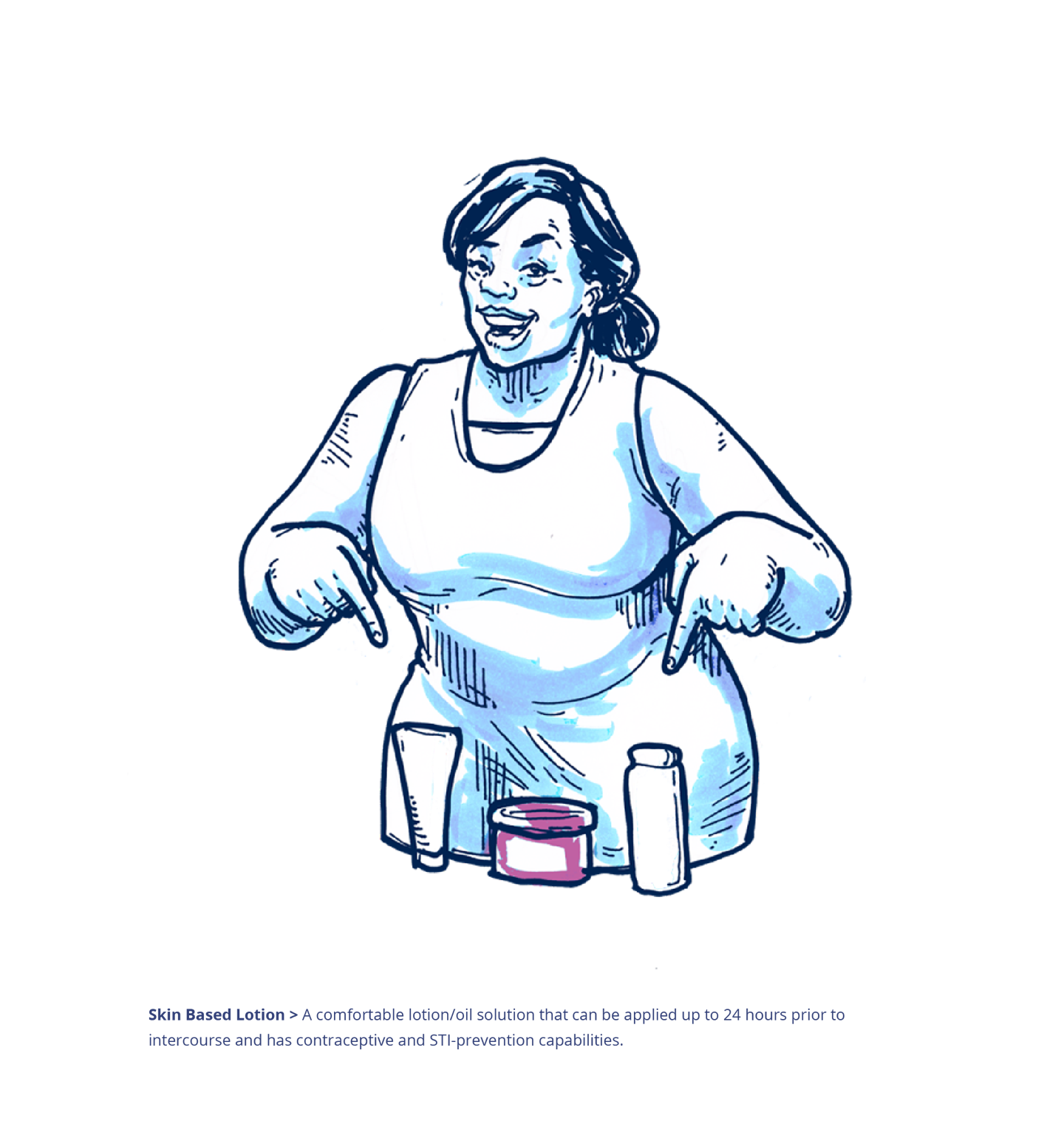
Biological Milestones
Key biological milestones like menstruation or having a first child are most often the times during which users gain awareness of their options or are reminded to explore new ones.
Can contraceptive methods better match women’s existing routines?
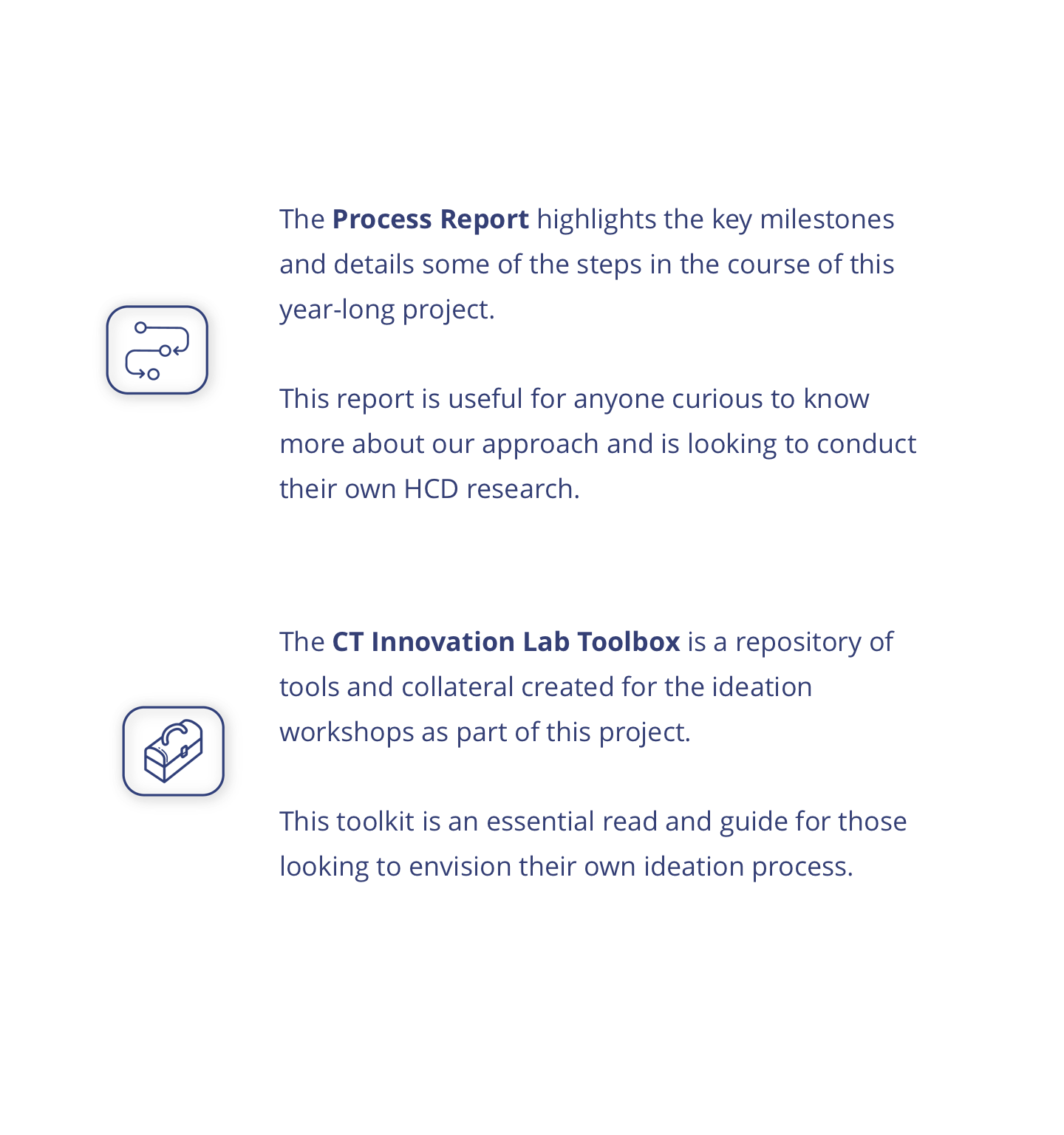
The Project Report contains in-depth insights into the contraceptive needs of women in low-income settings.
The report details out each of the sections above* ; the context and research methodology, detailed findings from research, synthesized user profiles and considerations for new contraceptive design.
Suitable for anyone designing programs based on user perspectives or developing new contraceptives that deeply satisfy users, the CT Innovation Lab Report is meant to inspire your own product innovation process.
* If you would prefer to read the report in modules, you can download each section separately.
-
 Context Setting
-
 Findings From Research
-
 User Profiles
-
 CT Design Considerations
-

 CT Innovation Lab Report
(Complete Report)
CT Innovation Lab Report
(Complete Report)
-

 CT InnovationLab Webinar
(Coming Shortly)
CT InnovationLab Webinar
(Coming Shortly)
This project was conducted by multiple partners.
FHI 360, a non-profit organization dedicated to improving lives in lasting ways by advancing integrated, locally driven solutions.
Quicksand, a design thinking and innovation consultancy based in India and working across the global south.
Pabla Van Heck, a freelance social intrapreneur who helps organizations navigate the fuzzy front end of social innovation for emerging markets.
This work was funded by The Bill & Melinda Gates Foundation whose goal is to bring access to high-quality contraceptive information, services, and supplies to an additional 120 million women and girls in the poorest countries by 2020 without coercion or discrimination, with the longer-term goal of universal access to voluntary family planning.
We hope that this foundational work forms the basis for ongoing efforts in the space - to focus on continuously innovating on revolutionary products that are rooted in user needs and can dramatically improve their contraceptive experience.
If you have any questions or would like to discuss this work further, please write to us.
hello@quicksand.co.in